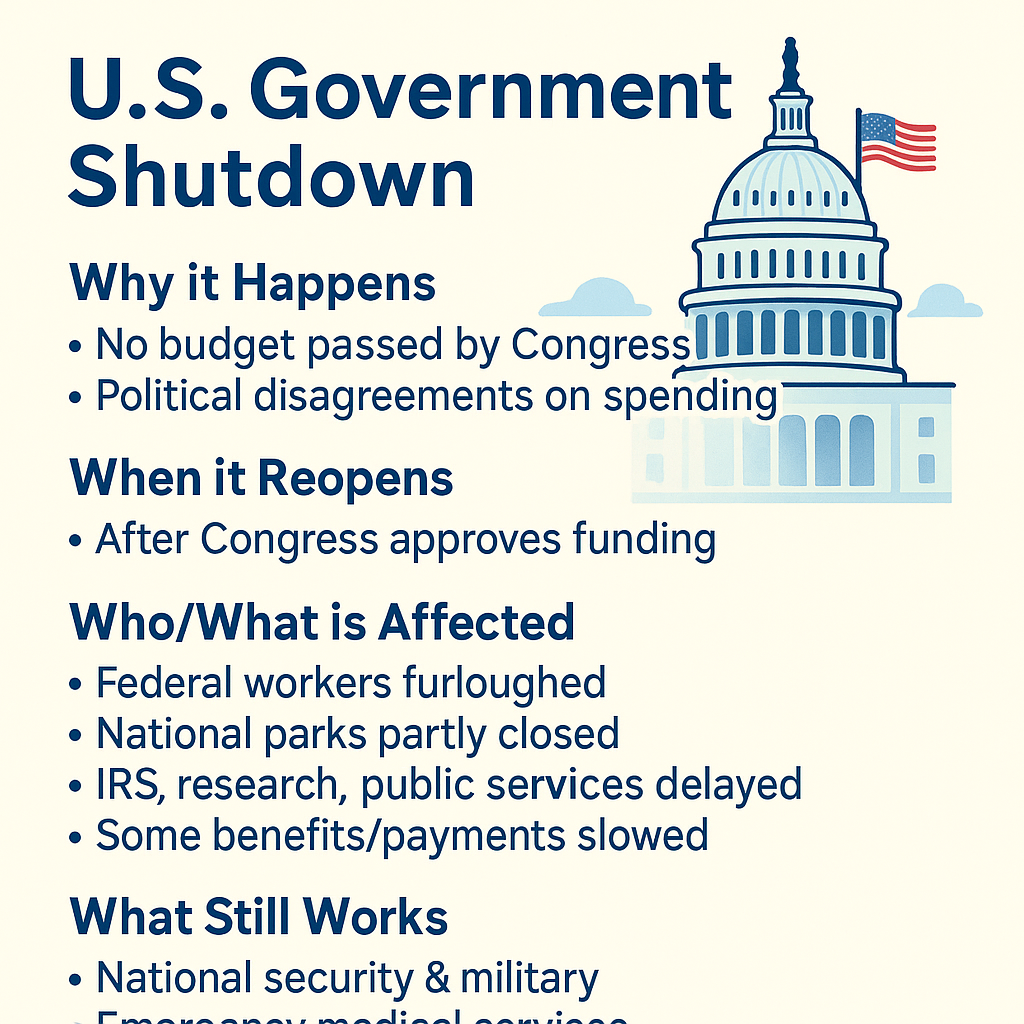
Why does the U.S. government “shut down”? When does it reopen? And what does it affect?
A U.S. government “shutdown (Government Shutdown)” does not literally mean the whole government stops. It happens when Congress fails to pass a budget or stopgap funding before the new fiscal year begins, so some federal agencies have no money to keep operating.
In 2025, at 12:01 a.m. (Eastern Time) on October 1, 2025, the U.S. federal government officially shut down.Wikipedia+3U.S. Representative Ami Bera+3tonko.house.gov+3
Why it shut down, and the fight behind it
-
Budget deadlock: Congress did not approve a new budget or a stopgap funding bill (continuing resolution) by September 30.Representative Shontel Brown+2tonko.house.gov+2
-
Partisan divide: Democrats and Republicans could not agree on health insurance subsidies, foreign aid, the level of government spending and other policy differences.AP News+2The Washington Post+2
-
Fights over priorities: which spending to protect and which programs to cut is at the heart of the dispute between the two parties.Holland & Knight+1
So when does it “reopen”? In principle, only after Congress passes an appropriations bill (or a continuing resolution) and funding is restored does the government gradually return to full operation. How long that takes depends on political negotiations; it could be days or weeks.
What does a shutdown affect?
These are the effects most of us are likely to notice:
| Area | What may be affected or stopped | Notes |
|---|---|---|
| Federal employees | Some non-essential employees are furloughed (unpaid leave) | Some employees must keep working but may be paid late Reuters+3Reuters+3Reuters+3 |
| National parks and attractions | Some buildings and facilities close; roads and trails may stay open | The Park Service will cut staff and maintenance The Guardian+2The Washington Post+2 |
| Health and public health | Staff at several agencies are temporarily furloughed; disease surveillance and research may be affected | For example, a large share of CDC and NIH staff will be furloughed Reuters+2Wikipedia+2 |
| Social welfare and assistance | Some benefits and funding programs may be delayed or paused | For example, food assistance and housing aid in some areas may be affected Wikipedia+2tonko.house.gov+2 |
| Taxes and financial reporting | Agencies such as the IRS are short-staffed, so tax filing, reviews and other work may be delayed | Tax services may slow down or have longer wait times Reuters+1 |
| Credit ratings and market confidence | Rating agencies may change their view of U.S. government credit | Europe's Scope has warned that the shutdown is bad for the credit rating Reuters |
What should ordinary people do? What should you watch for?
-
Don't panic: some essential services (such as defense, emergency medical care and security agencies) keep running.
-
Have a backup plan: if you need a service from a federal agency (visas, immigration, benefits and so on), it may be delayed.
-
Watch for announcements: keep an eye on notices from government agencies, Congress or your representative's office.
-
Prepare your finances: if you are a federal employee or contractor, your income may stop for a while.
-
Check your park and travel plans: if you plan a trip, first check whether your destination is affected.
Final thoughts
A U.S. government shutdown may look like political news, but it has many real effects on daily life. Knowing the causes, the effects and how to respond helps you be better prepared through the storm and avoid panic.
👉 In one sentence:The U.S. government shut down on October 1, 2025 because no budget was passed. If funding is not negotiated quickly, many non-essential federal services will be paused, so stay informed and have a backup plan for daily life.