The 2026 job market has one harsh but very clear pattern:
job switchers are splitting into two extremes.
Some get a 20–40% raise in one move,
while others find out after switching that their “market value isn't as high as they thought.”The question isn't whether you work hard enough.
It's whether you're jumping from “the right position.”This article won't tell you “whether to jump.”
It helps you figure out:
👉 whether you're the kind of person who “gets a raise the moment you jump,” or one who “shouldn't move right now.”
🧠 1. The big picture first: how is the 2026 job-switching market different?
The 2026 workplace has three clear changes:
1️⃣ Companies are more willing to pay more for “people who can deliver right away”
2️⃣ Mid-level roles are being squeezed, and the split is obvious(either junior or highly productive)
3️⃣ With AI everywhere, “people who know how to use the tools” are worth more than “people with long tenure”👉 So switching jobs in 2026
isn't about changing where you work. It's about repricing yourself.
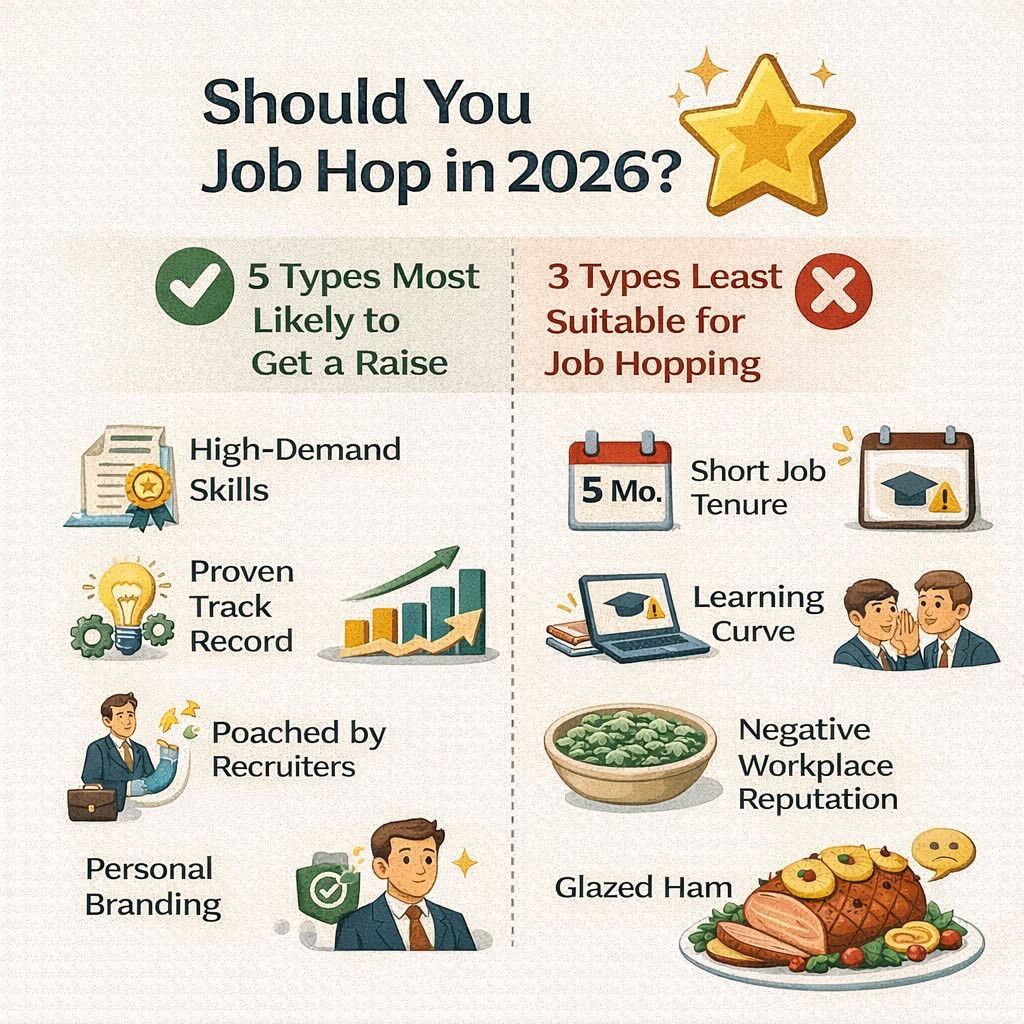
✅ 2. The 5 types of people “most likely to get a raise by switching” in 2026
⭐ 1️⃣ People who can “plug AI and tools directly into the workflow”
Not people who can chat with it or play around with it,
but people who can:
deliver faster with AI
cut labor with tools
multiply efficiency with systems
👉 Companies pay a premium for people who can “save money or make money right away.”
⭐ 2️⃣ People with “cross-functional results,” not just a single skill
For example:
Marketing + data
Product + user research
Operations + automation
👉 In 2026 the market isn't short on specialists.
What it's short on is “people who can bridge different departments.”These people usually have the most room to negotiate when they switch.
⭐ 3️⃣ People already doing “the next level's work”
If your current situation is:
your title hasn't been promoted yet
but your responsibilities were promoted long ago
your work has outgrown your title
👉 then you shouldn't wait for a raise.
You should let the market set your price.
⭐ 4️⃣ People who can clearly say “what value they create for the company”
Not:
❌ I'm responsible for a lot of things
❌ I work very hardBut:
✔ What problem I solved for the company
✔ How much cost / time I saved
✔ What results I delivered👉 Only people who can explain their value clearly are in a position to negotiate a raise.
⭐ 5️⃣ People who judge industry trends instead of only looking at salary
Before switching, these people think about:
whether this company will still be around in 2–3 years
whether my skills will become obsolete
whether this move takes me “upstream”
👉 They aren't just switching jobs; they're “changing lanes.”
❌ 3. The 3 types of people “least suited to switching jobs” in 2026
🚫 1️⃣ People who haven't figured out their market value
If you:
don't know what you're worth on the market
can only describe your duties in interviews
can't quantify your results
👉 switching now
can easily get you undervalued, or even paid less with each move.
🚫 2️⃣ People who use switching jobs as an escape
For example:
you can't stand your manager
you think the company culture is bad
you've been tired lately
👉 The problem is:
changing companies won't automatically close the skill gaps you don't want to face.
🚫 3️⃣ People whose skills are stuck in “the 2019–2021 version”
If right now you:
rarely try new tools
have no sense of AI, data or process optimization
work the same way you did 5 years ago
👉 the 2026 market won't go easy on you just because you're loyal.
💡 4. Four things you must do before switching jobs in 2026
This is the part many people regret skipping.
1️⃣ Estimate your “market value range”
2️⃣ Look at how skill keywords for the same role are changing
3️⃣ Figure out whether you're “someone being poached” or “someone filling a gap”
4️⃣ Be clear: is this move a raise, or just buying time?👉 Switching jobs isn't a decision; it's a result.
🧭 5. A more important question: what kind of person do you want to be?
After 2026, the workplace will split more clearly into two kinds of people:
people who passively wait to be assigned
people who actively build their own market value
Switching jobs is just one option.
The real gap is:
👉 whether you keep yourself “worth being poached by a better company” at any time.
🎯 Final thoughts: 2026 isn't about “should I jump,” it's about “am I ready”
Switching jobs won't make you more valuable by itself;
the market only pays for “people who are already prepared.”If after reading this
you have a clearer idea of where you stand now,
you're already a step ahead of most people.

AI literacy and skills | Where do you start?
You don't need to study CS.
You don't need to pay for engineering school either.
What you need is:
✔ a platform that lets you “start from zero”
✔ and steadily build up your data + AI skills
✔ with skills the future workplace will really use
That's why a lot of people choose DataCamp.
This platform's strength isn't turning you into an engineer.
It's letting you:
⭐ “quietly level up your skills,
while your coworkers have no idea how you got so good.”
You'll go from:
-
not being able to read data
→ to someone who can read a dashboard, analyze trends and talk with a PM.
You'll go from:
-
only writing prompts
→ to someone who uses AI to build prototypes and automate workflows.
You'll go from:
-
knowing nothing about Python
→ to using basic syntax to handle data and find insights your coworkers miss.
You'll go from:
-
a stalled career
→ to someone the company sees as “high-performing talent worth a raise.”
Honestly, this is the secret weapon many people quietly use to “move to a better job and a higher salary”: Datacamp

If you want to make yourself more valuable in 2026, you can start with these three steps:
① Learn data literacy (Data Literacy)
→ DataCamp is a good place to start
→ you can use it at work right away
② Learn to build prototypes with AI (Vibe Coding)
→ you'll put together proposals 3 times faster than your coworkers
③ Learn to test ideas with data
→ this is the skill bosses value most
→ it directly strengthens your salary negotiations
📌 One last word (for those quietly trying to get better)
2026 won't be about AI replacing people.
It will be about:
people who know AI + data
starting to replace people who don't.
If you want to make yourself in 2026 more valuable,
harder to replace and paid one level higher,
building up your AI + data skills is the best-value investment.
And DataCamp
is the platform where “nobody notices you're training, but your skills quietly get stronger.”
⭐ DataCamp is an online learning platform that lets you “learn data skills without being an engineer”
DataCamp is an interactive online learning platform focused on data science, artificial intelligence (AI) and data analysis skills. It's a great fit if you want to learn data tools and technologies such as Python, R, SQL, Power BI and Tableau.
📍 What is DataCamp?
-
It offers structured online courses that go from beginner to advanced, combining short video lessons with hands-on practice (you write code right in your browser), so you learn by doing.
-
It suits beginners, people who want to switch into data work, and people who want to sharpen their job skills.
-
Courses cover many topics: core languages (Python, R, SQL), data analysis and visualization, machine learning and AI, business intelligence and more.
-
There are also Career Tracks and hands-on Projects to help you organize your learning around your goals.
💡 Key features
✅ Interactive learning
Short videos plus live coding exercises: you don't just watch the lessons, you also solve problems.
✅ Write code right in the browser
No need to set up your own local environment (like Python or Jupyter Notebook), so it's easier for beginners.
✅ Covers a wide range of topics and tools
From data cleaning and analysis to visualization and model building, with some courses also covering advanced skills like AWS and Azure.
✅ Personalized learning paths and assessments
Skill assessments, certificates and a profile page let you show what you've learned.
💸 Pricing and free options
-
Free account: lets you try some chapters or a limited number of exercises.
-
Paid subscription: paying annually is usually the better deal (for example, from about $14/month, or an annual plan of about $168/year), with full access to all courses, projects and certificates.
📊 Pros and things to watch for
Pros
-
Clear structure, good for starting from zero.
-
Practice-focused, so you actually build the skills.
-
Good for people who want a foundation in data analysis or data science.
Things to watch for
-
Some users find the courses more beginner or intermediate, so for advanced, real-world work you may need other resources too.
-
The certificates aren't university credentials, so they may have limited value if you're counting on them to get a job (but real projects and skills matter more).
It breaks hard-sounding things like data analysis, Python, SQL and using AI tools into lots of small practice steps, so even people with no background can keep up.
The courses are mostly interactive:
instead of watching videos nonstop, you learn by doing, typing code and seeing the results as you go.
You'll quickly know whether you've really learned it.
If you just want to learn to:
-
understand data
-
do simple analysis
-
use AI tools
-
work with Excel and spreadsheets
-
or automate some of your work
DataCamp's courses are really enough.
Companies also often use it as a platform for “upskilling the team,” because you can get up to speed on data and AI ways of working without writing difficult code.
In short:
it won't make you an engineer, but it will help you understand data better and use AI more effectively.
