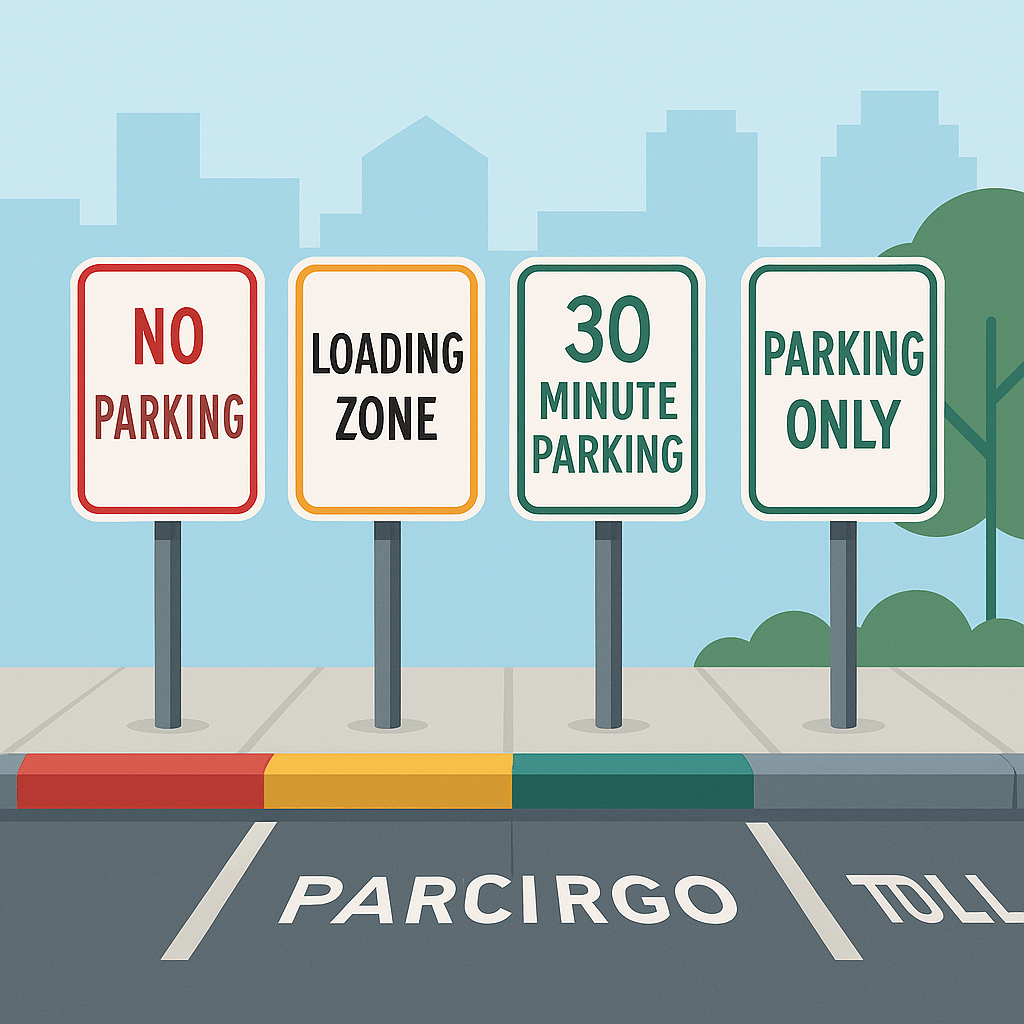
U.S. Parking Rules and Signs Explained: Red, Yellow, Green, Blue and White Curbs Made Simple!
For newcomers driving in the U.S., one of the most common headaches is parking violations. Curb colors (Curb Colors), together with all kinds of street signs, decide whether you can park and for how long. If you don't know the rules, at best you get a ticket; at worst your car gets towed, and you may even end up with a violation on your record. This article walks you through the most common parking rules and signs in the U.S.
📌 What the common curb colors mean in the U.S.
1️⃣ Red curb (Red Curb)
No stopping or parking at all.
Common next to fire hydrants, emergency areas and emergency lanes.
Even a quick pick-up or drop-off can get you a ticket.
2️⃣ Yellow curb (Yellow Curb)
Usually a loading zone or for commercial vehicles.
Often has time limits (for example, "Loading Only 7AM–6PM").
If you stay parked outside the allowed time, you'll be fined.
3️⃣ White curb (White Curb)
A short stop for passengers to get in or out.
The driver must stay in the car, ready to drive off.
4️⃣ Green curb (Green Curb)
Short-term parking (such as 15 minutes, 30 minutes or 2 hours).
Follow the time limit shown on the sign.
5️⃣ Blue curb (Blue Curb)
Reserved for people with an officially issued disabled parking placard (Disabled Placard).
Parking there without a placard can mean a heavy fine or a tow.
6️⃣ Unpainted curb (Unpainted Curb)
Follow the nearby signs (Signs) or general parking laws.
📌 Street signs and special rules
No Parking: No parking (sometimes only during certain hours, for example "No Parking 2AM–6AM").
Street Cleaning: No parking during regular street sweeping hours; violators get towed.
Parking Meter (parking meter): Pay with coins or a phone app; if you go over time, you'll automatically get a ticket.
Temporary no-parking: Winter snowstorms, construction or city notices can bring extra rules.
📌 Parking tips you need to know
Carry coins or a credit card: Some parking meters still need coins.
Use mobile payment: Many cities support apps such as ParkMobile and PayByPhone.
Set a reminder: Use a countdown timer on your phone so you don't forget to move your car.
Apply for a residential parking permit (Permit Parking): Some cities offer street parking permits just for residents, which you display on your car window.
📌 Common no-parking spots (never park here!)
In front of a fire hydrant (Fire Hydrant)
Crosswalks or wheelchair ramps
Other people's driveways
Bus stops and school drop-off zones
📌 Bottom line
U.S. parking rules may look complicated, but once you understand the principle of curb color + street signs, you can greatly cut your risk of getting a ticket or towed.
👉 In one sentence: red means no stopping, yellow means loading, white means passenger pick-up and drop-off, green means time-limited, blue means disabled parking only. Remember these five key points and you can park in the U.S. with peace of mind! 🚗
I'm C. I'm from Taiwan and now run a business in Los Angeles. When I first arrived, the challenges were everywhere! From the language barrier to culture shock, every small detail took me a long time to figure out. Those experiences taught me how to adapt quickly here, until I was in my element. I've put years of that experience on this site to help newcomers like me settle into life in the U.S. more easily and quickly. Whether it's moving here, finding a job or handling everyday tasks, you'll find plenty of practical shortcuts and solutions so you can skip the detours. I hope what I share helps you start your new life in America smoothly, with less effort and a lot more fun!