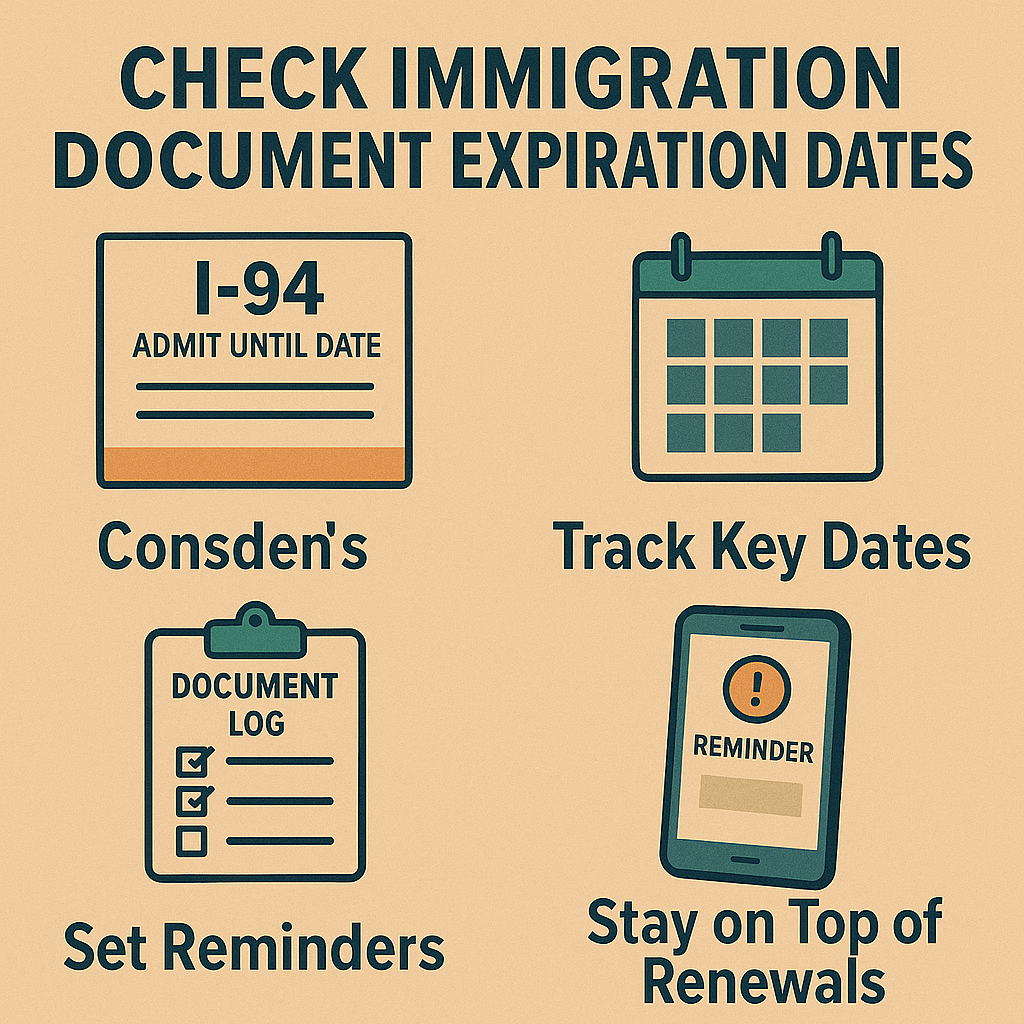
Don't Let Your Status Expire in the U.S.! How to Check Your Immigration Document Expiration Dates and Never Forget to Renew
When you're new to the U.S., the scariest thing isn't being unable to pay rent. It's your status expiring. Whether you're on an F-1, J-1, H-1B, E-2 or L-1, or holding an EAD, AP or I-20/DS-2019, if you don't keep track of your "expiration dates," you could step on the landmine of unlawful presence. This article shows you how to sort out all your expiration dates at once, set reminders and renew with peace of mind.
Get it straight: which "expiration points" should I check?
Check all four of the categories below and build your "status map":
Arrival record: I-94
Once you enter the U.S., your I-94 determines how long you can legally stay (Date of Admit Until).
Students often see D/S (Duration of Status), which means you can keep staying as long as your status is valid and you follow the study/work rules. But don't think that means you don't need to keep track: your I-20/DS-2019, work authorization and so on still have their own deadlines.
How to check: cbp.gov → I-94 lookup.
Main status documents
F-1: I-20 program end date.
J-1: DS-2019 end date.
H-1B/L-1/E-2 and others: the validity period on your I-797 approval notice.
The visitor/work visa stamp (the visa in your passport) affects your re-entry, but how long you can stay in the U.S. depends on your I-94/status documents.
Work and travel authorization
EAD (work permit): the validity date on the card; most jobs require a valid EAD before you can work.
Advance Parole (AP): the validity period of your travel document for leaving and re-entering the U.S.
Passport
Most state agencies and airlines require a passport to have at least 6 months of validity; a passport that expires too soon can also limit how long other documents are issued for.
How far ahead should you start preparing?
Here's a conservative, realistic timeline that works for most situations:
Passport: 9–12 months before it expires, apply to renew it.
I-20 / DS-2019: 90–120 days before it expires, contact your school/program sponsor about an extension.
H-1B / L-1 / E-2 / other nonimmigrant work visas: 6 months before it expires, talk to your employer and a lawyer and prepare the extension.
EAD (work permit): most categories can file within 180 days before it expires, and some categories get an automatic extension once the receipt notice is issued (depending on the category).
AP (travel): 4–6 months before it expires, file.
Driver's license/state ID: usually tied to your immigration status; update it as soon as possible after your status is extended.
Note: The details differ by visa type. It's best to confirm the rules that apply to you, and whether there's an automatic extension, with your school's DSO / your employer's HR / a lawyer.
Don't want to forget? Use this "three-layer reminder system"
Layer 1: Master sheet
Create a "status tracking sheet" with columns for the document name, document number, expiration date, earliest filing date, contact (DSO/HR/lawyer), required materials, last filing date and receipt number (Receipt #).
Take a photo of or scan every document and save them in the same cloud folder (with the expiration date in the file name).
Layer 2: Calendar
Set three reminders in Google Calendar:
T-180 days (or the earliest filing date allowed)
T-90 days (check that your materials are complete and confirm appointments)
T-30 days (final progress check so nothing falls through)
Important: turn on email + mobile notifications.
Layer 3: Track progress
After you file, add the receipt number (IOE/MSC/WAC…) to your sheet and bookmark the USCIS Case Status page.
Set up a recurring reminder to check every two weeks until it's approved or your card arrives.
Renewal document checklist (based on most cases)
Proof of identity: passport, I-94, and your current I-20/DS-2019 or I-797.
Two passport photos (to the application's specifications).
Proof of funds/employment: I-20 extensions often require financial documents; work visas require supporting documents from your employer.
The filing fee, a check or a credit card authorization form.
Previous approval notices, and copies of the front and back of your EAD/AP.
Proof of any name change or change of address.
Turn the "application materials list" into your own standard checklist, and just tick it off each time.
Common pitfalls
Only looking at the visa stamp: how long you can stay in the U.S. depends on your I-94/status documents, not on the visa stamp.
Forgetting that your passport is about to expire: a passport without enough validity affects the DMV, your school and immigration applications.
Acting after the filing date: popular visa types have quota or backlog pressure, so the earlier the safer.
Moving without updating your address: USCIS notices get lost; remember to file AR-11 online.
Overlapping EAD/AP timing: plan ahead so that "work isn't interrupted" and "you can still travel in and out."
Handy tools & habits
USCIS online account: link your cases, get messages, and download receipts and decisions.
Case Tracker App: enter your receipt number to track it automatically (available on iOS and Android).
Set up regular check-ins with HR/DSO: once a quarter, to confirm whether any policies or documents have changed.
File naming rules: 2025-06-15_I-20_enddate.pdf, 2026-01-01_EAD_exp.pdf, so you can tell at a glance.
Final thoughts
Make "expiration date management" your everyday SOP: build a master sheet → set three layers of reminders → track regularly. Start renewals 90–180 days early, and you can avoid almost 90% of status risks. Instead of scrambling at the last minute, turn the process into a habit, so you can live with peace of mind and skip the detours. 🚀
I'm C. I'm from Taiwan and now run a business in Los Angeles. When I first arrived, the challenges were everywhere! From the language barrier to culture shock, every small detail took me a long time to figure out. Those experiences taught me how to adapt quickly here, until I was in my element. I've put years of that experience on this site to help newcomers like me settle into life in the U.S. more easily and quickly. Whether it's moving here, finding a job or handling everyday tasks, you'll find plenty of practical shortcuts and solutions so you can skip the detours. I hope what I share helps you start your new life in America smoothly, with less effort and a lot more fun!