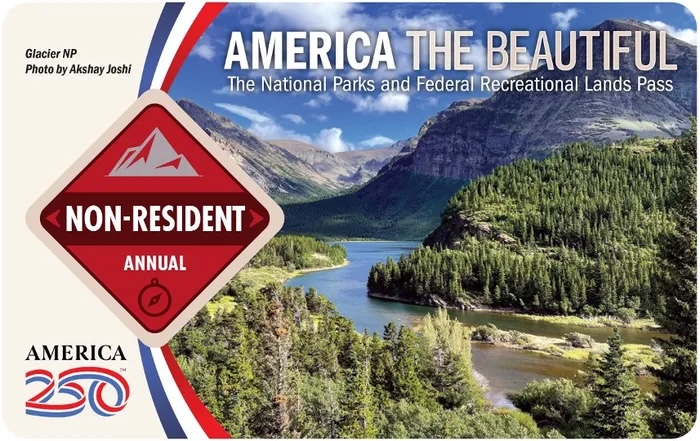
Starting January 1, 2026, the way U.S. national parks charge fees is getting a major shake-up.
The U.S. Department of the Interior has officially announced that theAmerica the Beautiful annual pass will have two prices, a "resident" price and a "nonresident" price:
-
U.S. residents: the annual pass stays at $80
-
Nonresidents: the annual pass goes up to $250 U.S. Department of the Interior+1
In addition,nonresidents without an annual pass will pay an extra $100 per person to enter the 11 most popular national parks, on top of the regular entrance fee.AP News+1
For people from abroad who live, study or work in the U.S., this change matters a lot:
Who exactly counts as a resident? Do F-1, H-1B and E-2 holders count? Will you end up in the group that pays $250?
Below I break it down for you from the point of view of new immigrants and international students.
1. First, what is the America the Beautiful pass?
America the Beautiful – The National Parks and Federal Recreational Lands Pass
Simply put, it's anationwide combined pass that gives you unlimited entry for one year to most:
-
National Parks (National Parks)
-
National Monuments (National Monuments)
-
National forests, wildlife refuges and other federal recreation lands
In the past it cost $80 a year for everyone, regardless of nationality or status, and was often called "the best-value annual pass in America." Most parks charge $30–35 per vehicle for a single entry, so it paid for itself after 3–4 visits.Wikipedia+1
2. The new 2026 system: how are resident and nonresident prices split?
According to the announcement from the Department of the Interior (Department of the Interior) and the National Park Service:U.S. Department of the Interior+1
Beginning Jan. 1, 2026, the Annual Pass will cost $80 for U.S. residents and $250 for nonresidents. Nonresidents without an annual pass will pay a $100 per-person fee to enter 11 of the most visited national parks, in addition to the standard entrance fee.
There are two key terms:
-
U.S. residents
-
Nonresidents / foreign visitors / international tourists
Judging from the press release and how major media outlets read it, "nonresident" meansforeign visitors, international travelers and foreign nationals, in other words people who are neither U.S. citizens nor U.S. permanent residents.AP News+1
And the point you raised yourself is exactly right:
The Senior Pass and Access Pass both explicitly require you to be a "U.S. citizen or permanent resident" to buy the discounted pass.
That means eligibility for the discount is tied to citizenship or a green card, not to "how long I've lived here" or "which nonimmigrant visa I hold."Wikipedia
So the more reasonable, conservative reading is:
If you are not a U.S. citizen or a permanent resident (green card holder), you will be classified as a nonresident under the new system.
That is also the conclusion you reached yourself later on. I fully agree; my previous version got this wrong.
3. So which side do F-1, H-1B and E-2 fall on?
Based on the logic of the current announcement and the rules for other pass types, it breaks down like this:
✅ Statuses that clearly count as U.S. residents and get the $80 annual pass
-
U.S. Citizen (U.S. citizen)
-
U.S. Permanent Resident (green card)
Why:
For the Senior Pass and Access Pass, the government states directly "U.S. citizens and permanent residents only", and this price increase is framed as keeping the original price for "taxpayers" and "American taxpayers."U.S. Department of the Interior
❓ F-1, H-1B, E-2 and other nonimmigrant visas → in practice, very likely treated as nonresidents
Including:
-
F-1 / F-2: students and dependents
-
H-1B / H-4: work visa holders and dependents
-
E-2: treaty investors and their spouses and children
-
O-1, L-1, J-1 exchange students/scholars, and so on
Even though these peoplelive in the U.S. long term and pay taxes, under immigration law they all have nonimmigrant status (nonimmigrant) and no permanent residence.
On top of that, the whole policy is framed politically as "America-first" and "foreign visitors pay more," and news coverage almost always equates nonresidents with foreign visitors / international travelers / foreign nationals.AP News+1
So from a "play it safe, don't get caught out" point of view:
F-1 / H-1B / E-2 holders should expect to be treated as nonresidents → $250 for the annual pass, and a $100 per-person surcharge at the popular parks.
Details on how fee stations will check status in practice, and whether they will ask for a passport or green card, haven't been fully released yet; even academics are criticizing that "enforcement will be very chaotic."usu.edu+1
But if you budget at the "nonresident price" from the start, you'll be on the safe side.
4. $250 annual pass + $100 surcharge at popular parks: how much more will you actually spend?
🧾 For nonresidents (including F-1 / H-1B / E-2 and others) starting in 2026:
-
Annual pass: $250 / year (America the Beautiful Annual Pass – nonresident)National Park Service
-
Without an annual pass, entering the 11 most popular national parks below costs an extra $100 per person (on top of the regular entrance fee):San Francisco Chronicle+1
For example:
-
Yellowstone
-
Yosemite
-
Grand Canyon
-
Zion
-
Bryce Canyon
-
Rocky Mountain
…and others (check that year's announcement for the actual list)
-
In other words, if you're an F-1 international student making one trip to Yellowstone:
-
No annual pass → the regular $35 per vehicle + $100 per person (nonresident surcharge)
-
Two people → possibly $35 + $200
If you visit a lot of national parks in a year,the $250 annual pass can still pay for itself; if you only go once in a while, do the math carefully.
5. How do you decide whether to buy the annual pass? (A few scenarios for people from abroad living in the U.S.)
🎓 Scenario A: an F-1 student in California
-
Plans: Yosemite + Joshua Tree + Zion within one year
-
Status: F-1 → nonresident → $250 annual pass
👉 Do the math:
-
Single entry: about $30–35 per vehicle at each park + $100 per person at the popular parks
-
With two people visiting 3–4 major parks, it may well still cost more than the $250 annual pass,
so in this case **buying the annual pass "all in one go"** gives you more peace of mind.
💼 Scenario B: an H-1B worker who takes the occasional weekend trip
-
Plans: only one trip to the Grand Canyon this year, maybe Zion as well
-
Status: H-1B → nonresident
👉 In this case it depends on how many people are in your family:
-
A family of four without an annual pass pays the $100 surcharge per person + the regular entrance fee
-
That gets close to $250 very quickly
-
If you plan to "go all-out on national parks for the next few years,"consider just getting the annual pass;
if you only go now and then for some photos, single-entry tickets probably make more sense.
👨👩👧👦 Scenario C: an E-2 family living in the U.S. long term who love national park road trips
-
Plans: a national park road trip every summer and spring break
-
Status: E-2 → nonresident
👉 Honestly, even at $250, as long as you visit national parks 5 or more times a year,
it still works out cheaper on average than paying "single entry + surcharge" every time.
So the key isn't your visa category, but:
How many times a year will you really go? Do you usually bring the whole family?
6. How to buy the annual pass (the process is the same, but more digital from 2026)
-
Buy online (recommended)
-
Buy a digital annual pass on recreation.gov or another official site
-
You can keep the pass in a phone app and just scan it at the entrance U.S. Department of the Interior
-
-
Buy in person
-
Buy at the Fee Station / Visitor Center at the park entrance
-
You'll need to show a passport or ID (in the future they will likely ask you to confirm whether you are a resident or a nonresident)
-
-
Note:
-
From 2026 the system will gradually move to digital passes first, with physical cards as a backup
-
There will also be more "residents-only fee-free days" that foreigners can't use New York Post+1
-
7. Summary: how should people from abroad living in the U.S. think about this price increase?
-
The status rule is simple:
-
Only "U.S. citizens" and "permanent residents (green card holders)" can use the $80 resident price
-
F-1, H-1B, E-2 and other nonimmigrant visas will most likely be classified in practice as nonresident → $250 annual pass
-
-
Will they really check that strictly?
-
Right now even research institutions are asking "how exactly will they tell who's who," and the Department of the Interior hasn't explained how it will work in practice.usu.edu
-
But when you plan your budget,estimate your costs as a nonresident from the start, so you won't get an unpleasant surprise later.
-
-
Should you buy the annual pass? Ask yourself three questions:
-
How many times a year will you visit national parks?
-
How many family members or friends will you bring each time?
-
Will your trips definitely include those 11 "popular parks with the extra $100"?
-
If you're planning to do the classic routes over the next while (the West Coast, Yellowstone, Arches, Bryce, the Grand Canyon),
then even at $250 the annual pass may still be "one painful payment up front, then smooth sailing the rest of the way" .