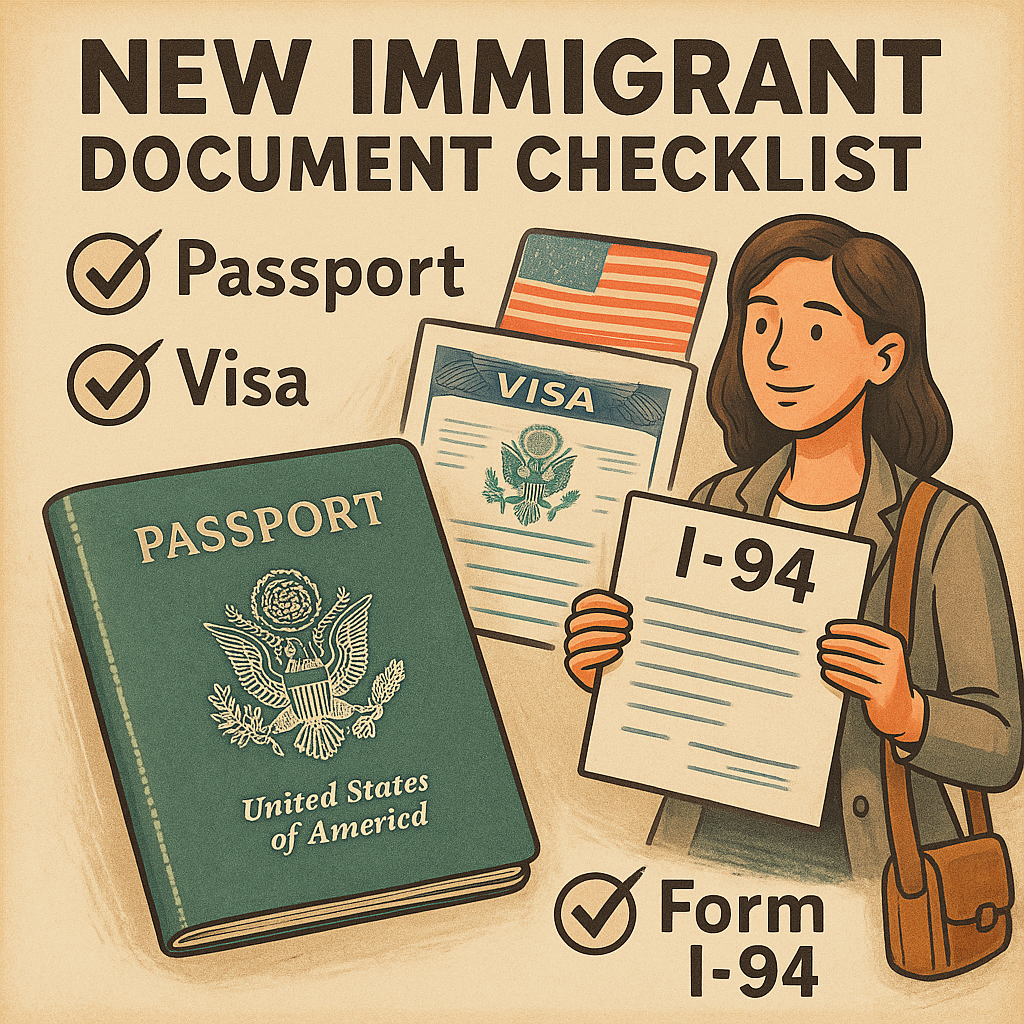
✈️ The Newcomer's Document Checklist: Passport, Visa, I-94 / I-797 / I-20 / EAD and SSN Explained
When you've just moved to the U.S., it feels like you have to start everything over. Opening a bank account, renting a place, getting a phone plan, starting work, filing taxes… but the starting point for all of it is the "documents" you have in hand. Are you ready? Or are you still unsure which documents you absolutely need and which can wait? Don't worry. This article lays out the documents every newcomer needs, all in one place, so life in the U.S. goes more smoothly!
📌 1. Passport (Passport)
🛂 Whether you enter on a student visa (F1), a work visa (H1B), a tourist visa (B2) or an immigrant visa, the first thing U.S. border officers look at is your passport.
What we recommend:
Make sure your passport is valid for at least 6 more months.
If it's about to expire, contact your country's embassy or consulate while you're in the U.S. to renew it.
When you're out, carry a copy of your passport + keep a backup in the cloud (such as Google Drive).
📌 2. Visa (Visa)
✈️ A visa is your ticket to be allowed into the U.S., but it doesn't mean you can stay indefinitely.
Common visa types:
F1 (student visa)
H1B (specialty work visa)
J1 (exchange visitor)
B2 (tourist visa)
L1 / E2 / O1 / TN… (depending on your situation)
Things to watch out for:
Once you've entered, your stay isn't affected even if your visa expires (that's controlled by the I-94), but after you next leave the country you'll need to apply for a new visa before you can come back in.
Some visas have to be used together with a work permit (such as an EAD).
📌 3. I-94 Arrival Record (Arrival / Departure Record)
📝 The I-94 is one of the most overlooked yet most important documents! It records the legal status you entered under and how long you can stay, and many reviews rely on it (driver's license applications, work permit applications, determining your tax status and more).
How to look it up:
After you enter the U.S., you can look up and download your I-94 here:https://i94.cbp.dhs.gov
Things to watch out for:
Make sure the entry date and status type on your I-94 (such as F1 or B2) are correct.
If you find a mistake after you've entered, contact the nearest CBP (U.S. Customs and Border Protection) office as soon as possible.
📌 4. I-20 / DS-2019 (students and exchange visitors only)
🎓 If you're in F1 or J1 status, your I-20 / DS-2019 is your proof of legal status.
What we recommend:
Always carry the paper copy when you enter the U.S.
Traveling abroad, transferring schools, internships and so on all require the school's DSO (international student office) to update and sign it.
📌 5. I-797 notice (if you're changing status or have been approved)
📬 This is the official approval notice from U.S. Citizenship and Immigration Services (USCIS). It means your change of status or another application has been approved.
Common types:
I-797A: comes with a new I-94 and means your status was extended or changed successfully.
I-797C: a notice or receipt; it does not mean approval.
I-797E: a request for more evidence (RFE).
📌 6. Social Security card (SSN)
🔐 If you're authorized to work, you can apply for a Social Security card (Social Security Number), which you'll use to file taxes, open bank accounts, get a phone plan and more.
How to apply:
If your visa allows you to work, bring your passport, I-94, visa and proof of employment to your local SSA office.
If you can't work, consider applying for an ITIN (Individual Taxpayer Identification Number).
📌 7. EAD card (work permit)
💼 If you work in the U.S. under OPT, H4 EAD, asylum or a similar status, you need an EAD (Employment Authorization Document).
Things to watch out for:
You can only work legally while the card is valid.
Apply to renew well before it expires (ideally more than 90 days ahead).
📌 8. Other supporting documents (depending on your situation)
📁 Depending on your status and purpose, you may also need the following:
Driver's license or ID (issued by the state)
Tax forms W-2 / 1099 / 1040
Lease / utility bills (proof of address)
Health insurance card
✨ Final thoughts: get your documents in order and you won't lose your way!
You may be thinking, "Wow, that's way too many documents," but if you organize them and back them up systematically, it's really not hard. Set up a cloud folder and scan every important document into it, so you don't have to worry about losing anything or not finding it when you need it in a hurry!
🧳 Newcomers face plenty of challenges, but with a little preparation, everything goes much more smoothly! 📦 Recommended next read: [How to adapt quickly after arriving in the U.S.: the 10 most common mistakes new immigrants make → read it here] 👉 /zh/new-immigrant-mistakes/
I'm C. I'm from Taiwan and now run a business in Los Angeles. When I first arrived, the challenges were everywhere! From the language barrier to culture shock, every small detail took me a long time to figure out. Those experiences taught me how to adapt quickly here, until I was in my element. I've put years of that experience on this site to help newcomers like me settle into life in the U.S. more easily and quickly. Whether it's moving here, finding a job or handling everyday tasks, you'll find plenty of practical shortcuts and solutions so you can skip the detours. I hope what I share helps you start your new life in America smoothly, with less effort and a lot more fun!