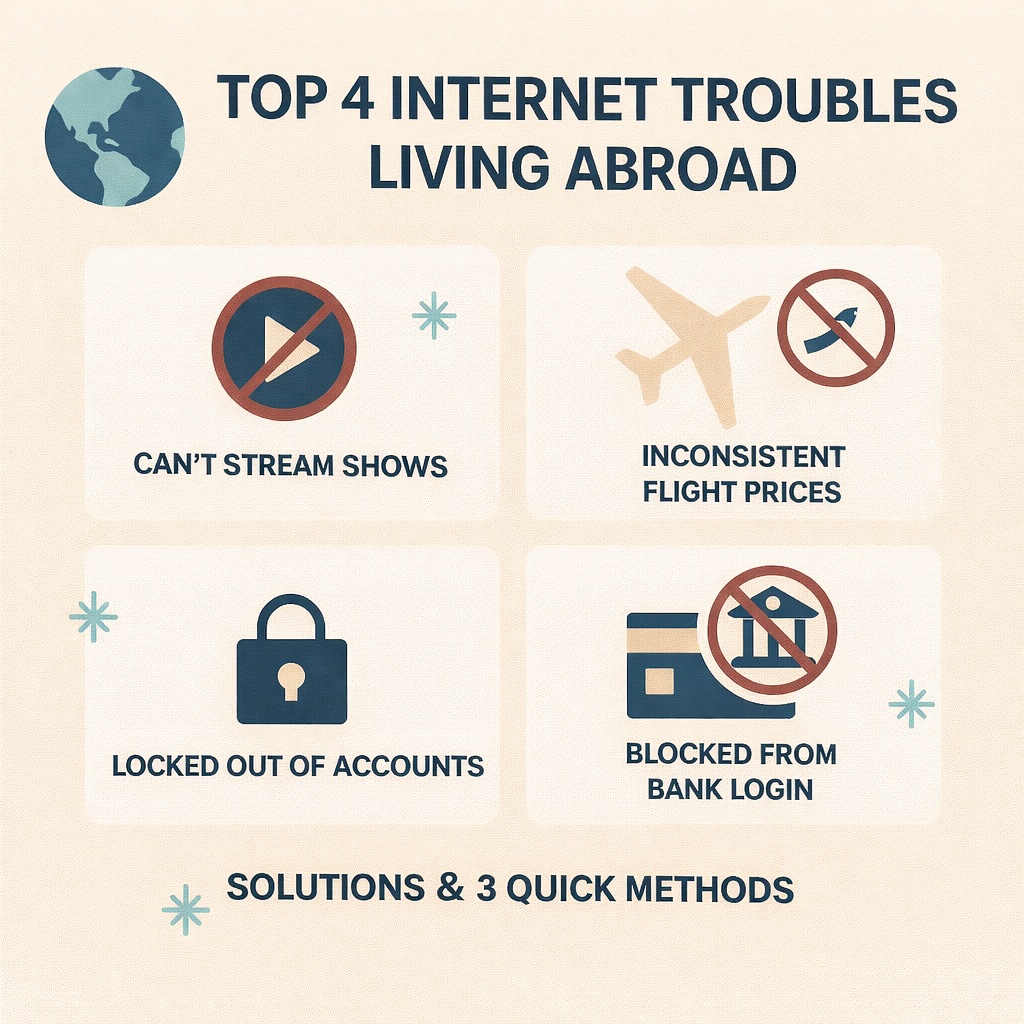
If you live in the U.S., Europe, Canada or Australia,
you've definitely run into these seemingly small but really annoying internet problems:
-
You want to watch a Taiwanese or Korean show, but it says "not available in your region"
-
Airfare and hotel prices are completely different from what your friends see
-
IG / YouTube / PayPal / Google flags your login as "unusual"
-
When you log in to your bank or a tax website, you're forced to verify again and again, or you're blocked outright
None of this is actually your fault.
The problem is this:
when you're online abroad, websites change their content and security checks based on your "IP region."
This article covers the 4 most common internet headachesof living abroad,
and gives you 3 of the fastest fixesso you can take care of all of them at once.
1️⃣ Headache 1: Can't watch Taiwanese dramas, K-dramas or variety shows? Content from other regions is locked
The most common problem of living abroad is this:
the content you most want to watch isn't available where you are.
Common situations:
-
You want Taiwan's Netflix → it automatically switches to the U.S. version
-
You want Korean variety shows or K-dramas → it says "This content is not available in your region"
-
You want to watch channels you used to follow on YouTube → region restrictions
-
KKTV, LINE TV, iQIYI and Disney+ TW are all locked
The reason is simple:
👉 the system decides whether you can watch based on "the country your IP is in."
As long as your IP isn't in Taiwan or Korea,
many platforms will simply lock the content.
2️⃣ Headache 2: Airfare, car rental and hotel prices look different for everyone?
You may have noticed this too:
the same plane ticket shows one price in Taiwan, another in Korea and another in the U.S.!
It even goes as far as:
-
Different car rental prices
-
Huge gaps in Netflix and YouTube Premium subscription prices
-
Hotel websites showing different prices by region
You're not imagining it.
👉 Many platforms set different prices depending on "where you're browsing from" (Geo Pricing).
In other words:
check the same ticket from another country, and it could be a lot cheaper.
That's why people who live abroad often say:
"Always change your region before you search for tickets."
3️⃣ Headache 3: When you file taxes or log in to your bank, the biggest risk isn't your password. It's the network you're using
When you log in to financial or government websites from abroad, you may have run into:
-
The IRS keeps asking you to verify
-
Your bank login is blocked and you're asked to call to confirm
-
You can't get into your credit card website
-
The platform flags it as a "suspected fraudulent login"
This isn't because you typed your password wrong,
but because:
👉 the system detected an "unsafe or unusual login environment."
Problems are most common in these situations:
-
Airbnb or hotel Wi-Fi
-
Shared apartment Wi-Fi
-
Public networks at coffee shops (the most dangerous)
-
An IP the platform doesn't recognize
Financial websites are very sensitive. If your network looks at all unstable, they block everything.
4️⃣ Headache 4: When you travel between countries, your accounts can suddenly get locked
What people living abroad run into most:
-
IG, FB or YouTube shows "suspicious activity"
-
Google thinks your account was hacked
-
PayPal or your bank account gets frozen outright
-
After you return to the U.S., you have to go through security steps to reset your account
The reason is this:
👉 the system sees you log in from "Country A" and then instantly from "Country B."
To the platform, that makes no sense, so it forces a lock on your account.
🔧 So how do you fix these common problems of living abroad all at once? The 3 simplest methods
✅ Method 1: Switch regions (log in from another region)
To watch Taiwanese dramas → switch to Taiwan
To watch Korean variety shows → switch to Korea
To find cheap flights → switch to the country you want to compare
Switching regions is the fastest and most effective fix.
✅ Method 2: Don't use public Wi-Fi to log in to your bank, tax sites or work files
Especially at:
-
Airports
-
Coffee shops
-
Mall Wi-Fi
-
Hotels
If you really have to use a public network, be sure to add a layer of encryption (such as a VPN).
✅ Method 3: Keep your IP stable when you travel so your accounts don't get locked
As long as the IP you log in from stays the same or close to it,
platforms like IG / PayPal / Google will flag you by mistake far less often.
🔚 Final thoughts: living abroad, the problem isn't that you don't know how to use the internet. It's that "when your network environment changes, the rules change"
Every problem you run into is actually normal:
-
Can't stream your shows
-
Prices don't match
-
Accounts get locked
-
Can't log in to financial websites
-
Public Wi-Fi isn't safe
All of these come down to where your IP is .
That's why many people living abroad use tools like NordVPN,
not because it's trendy, but because:
it happens to solve several of the biggest hassles of living abroad all at once.
🛡 Also: the 3 VPNs newcomers use most, and how they differ
Living abroad, you'll definitely run into region-locked content, locked accounts and public Wi-Fi risks, so many people start looking for a VPN. But there are many VPN brands out there. What's the actual difference?
Below are the 3 VPNs most used by newcomers, international students and people working abroad. Each has pros and cons.
1️⃣ NordVPN: the mainstream VPN most newcomers choose (stable and fast)
Pros:
-
A huge number of servers worldwide (covering key countries like Taiwan, Korea, Japan and the U.S.)
-
Fast with low latency, great for Taiwanese dramas / K-dramas / YouTube / Netflix
-
Stable logins across countries, less likely to be flagged as suspicious by platforms
-
Strong encryption, good for coffee shops and Airbnbs
-
Simple interface, very easy to learn
Cons:
-
You have to pay(but it's cheaper than many others)
-
Some servers get busy at peak times and you need to switch
Best for:
Newcomers, international students, frequent travelers and people who watch Asian entertainment.
2️⃣ ExpressVPN: a well-established international brand, also fast but expensive
Pros:
-
Very stable, almost never disconnects
-
Good for streaming shows, gaming across regions and video calls
-
Still works on platforms that are forcibly blocked (for example, in some countries)
Cons:
-
Pricey: the most expensive of the three
-
Fewer Asian servers than NordVPN
-
The app has more settings, a bit complicated for beginners
Best for:
People who care about speed and stability and don't mind paying more.
3️⃣ Surfshark: the cheapest, but speed is less stable
Pros:
-
One of the cheapest VPNs(great value for the price)
-
You can be logged in on many devices at once (handy for families)
-
Full features and a friendly interface
Cons:
-
Speed is sometimes unstable (shows sometimes lag)
-
Sometimes needs to reconnect when you log in from another region
-
Platforms sometimes detect the VPN (you need to switch servers)
Best for:
People on a budget and families who need to use it on many devices at the same time.
📊 The 3 VPNs compared (quick table)
| VPN | Stability | Speed | Number of servers | Streaming across regions | Security / encryption | Price | Ease for beginners |
|---|---|---|---|---|---|---|---|
| NordVPN | ⭐⭐⭐⭐⭐ | ⭐⭐⭐⭐✨ | ⭐⭐⭐⭐⭐ | ⭐⭐⭐⭐⭐ | ⭐⭐⭐⭐⭐ | Medium | Very easy |
| ExpressVPN | ⭐⭐⭐⭐⭐ | ⭐⭐⭐⭐⭐ | ⭐⭐⭐⭐ | ⭐⭐⭐⭐⭐ | ⭐⭐⭐⭐⭐ | Highest | Medium |
| Surfshark | ⭐⭐⭐ | ⭐⭐⭐ | ⭐⭐⭐ | ⭐⭐⭐ | ⭐⭐⭐⭐ | Cheapest | Easy |
🟦 Bottom line: all three work, but NordVPN comes out a little ahead on "stability, speed and choice of regions"
If you just want one stable, fast VPN that works well across regions ,
NordVPN has the best balance:
-
Not as expensive as ExpressVPN
-
More stable and faster than Surfshark
-
Servers in Taiwan, the U.S., Korea and Japan all run very smoothly
-
The easiest for beginners
The only downside → you have to pay.
But if you stream shows from other countries, compare ticket prices, log in to your bank or file taxes,
its stability and encryption really are much more reliable than a free VPN.