🏛️ How to Check in the U.S. Whether You Qualify for Local Government Benefits and Assistance
When people first arrive in the U.S., many don't know that state and county governments offer all kinds of benefits and assistance. But keep in mind that every state, and even every city, has its own eligibility rules. If you don't look them up yourself, you may miss out.
This article shows you:
Common types of benefits and assistance in the U.S.
How to check whether you qualify
Where to look things up and apply
Common pitfalls and quick reminders
📌 Common Benefits and Assistance Programs in the U.S.
1️⃣ Health coverage (Healthcare Programs)
Medi-Cal (California) or Medicaid (other states) → for low-income families, children, pregnant women and seniors
CHIP (Children’s Health Insurance Program) → health insurance for children
2️⃣ Living assistance (Living Assistance)
SNAP (food stamps / EBT card) → help paying for groceries
WIC (Women, Infants, and Children) → nutrition assistance for pregnant women and young children
Cash Aid / TANF → cash assistance for low-income families
3️⃣ Housing assistance (Housing Assistance)
Section 8 rental assistance
Public housing (Public Housing)
4️⃣ Unemployment and tax assistance
Unemployment Benefits (unemployment pay)
Earned Income Tax Credit (EITC) → a tax credit for people who earn income from work
📌 How Do You Check Whether You Qualify?
✅ Look at income (Income) Most benefits look at your family's annual income (Household Income), usually measured as a percentage of the Federal Poverty Level (FPL).
✅ Look at immigration status (Status)
Citizens, green card holders and some visa holders can apply
For new immigrants, some programs may have a waiting period (for example, the 5-year waiting period for green card holders)
✅ Look at your family situation
Whether you have children, a pregnant family member or seniors in the household all affects eligibility.
📌 Where Do You Look Things Up and Apply?
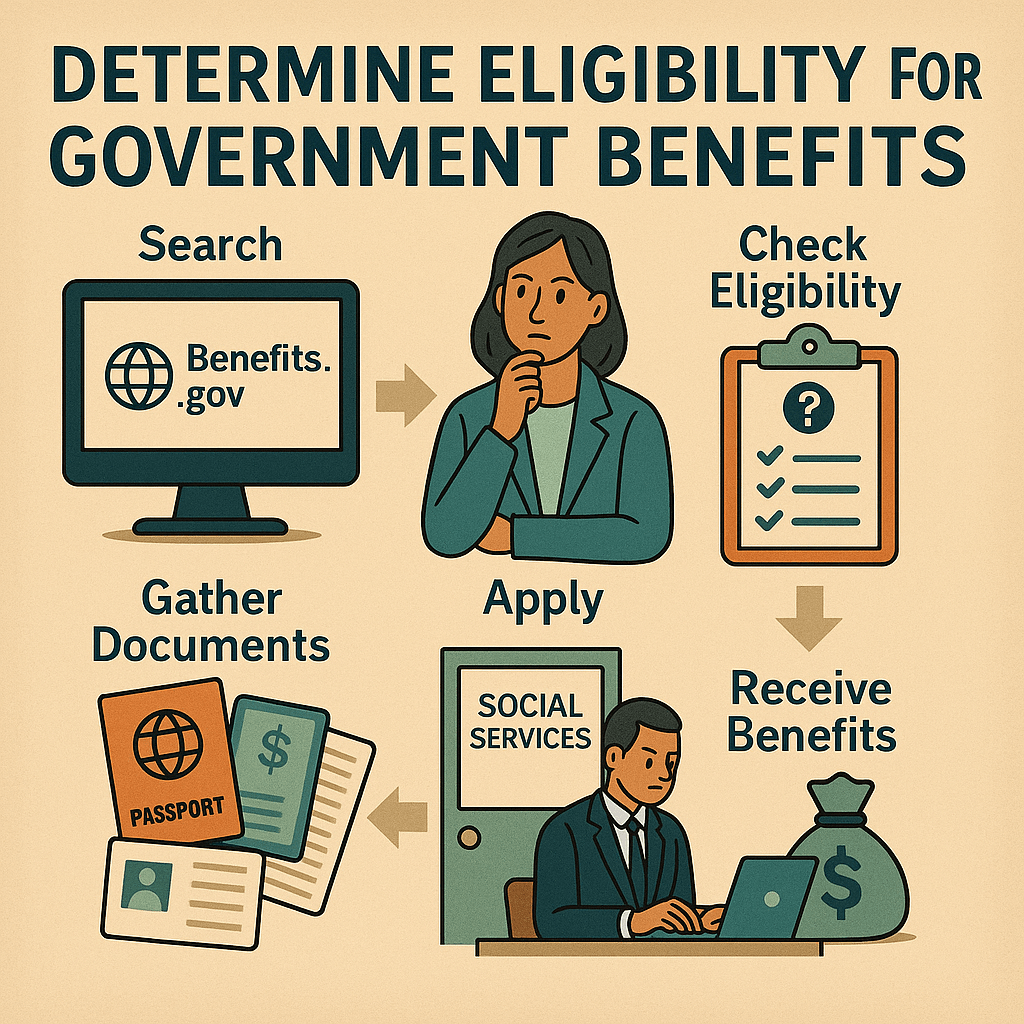
1️⃣ official website
Benefits.gov → a nationwide benefits search site
Each state's MyBenefits site (for example, California's MyBenefits CalWIN)
2️⃣ Your local social services office (County Social Services Office)
You can apply online or in person, and a caseworker reviews your application.
3️⃣ School and hospital resources
Schools often help low-income families apply for free or reduced-price lunch
Hospitals and clinics offer help with Medi-Cal/Medicaid questions
📌 Common Pitfalls and Quick Reminders
⚠️ Thinking that "immigrants can't apply for benefits" → In fact, immigrants can apply for some benefits, such as children's health coverage, WIC and unemployment benefits (if you have a record of legal work).
⚠️ Relying only on Google searches → Many ad-driven sites charge a fee to apply for you, when you can apply for free on the official websites.
⚠️ Not having all your documents ready → When you apply, you usually need: your passport/green card, proof of income (Pay Stub), your lease and utility bills.
📌 Bottom Line: Check First So You Don't Miss Out!
When you live in the U.S., benefits and assistance are important resources that help new immigrants get settled. ✔️ Start by searching on Benefits.gov or your state's MyBenefits site ✔️ Confirm that you meet the income / status / family requirements ✔️ Get the documents you need ready and apply online
👉 If you qualify for benefits, you can make good use of them. But if you or a family member plans to apply for a green card or an immigrant visa later, first learn about the "public charge" rules. DHS's new rule applies to applications for admission filed on or after September 18, 2026, and to adjustment of status applications that are subject to a public charge review. Any means-tested benefits received on or after 9/18 may be considered; for benefits received before that date, only public cash assistance for income maintenance and government-funded long-term institutional care are considered. Immigration officers look at the totality of your circumstances and decide case by case. Other than the lack of a sufficient Form I-864 affidavit of support, no single factor can be the sole reason for a denial. For exempt categories and details on how the rule applies, refer to USCIS guidance.
I'm C. I'm from Taiwan and now run a business in Los Angeles. When I first arrived, the challenges were everywhere! From the language barrier to culture shock, every small detail took me a long time to figure out. Those experiences taught me how to adapt quickly here, until I was in my element. I've put years of that experience on this site to help newcomers like me settle into life in the U.S. more easily and quickly. Whether it's moving here, finding a job or handling everyday tasks, you'll find plenty of practical shortcuts and solutions so you can skip the detours. I hope what I share helps you start your new life in America smoothly, with less effort and a lot more fun!