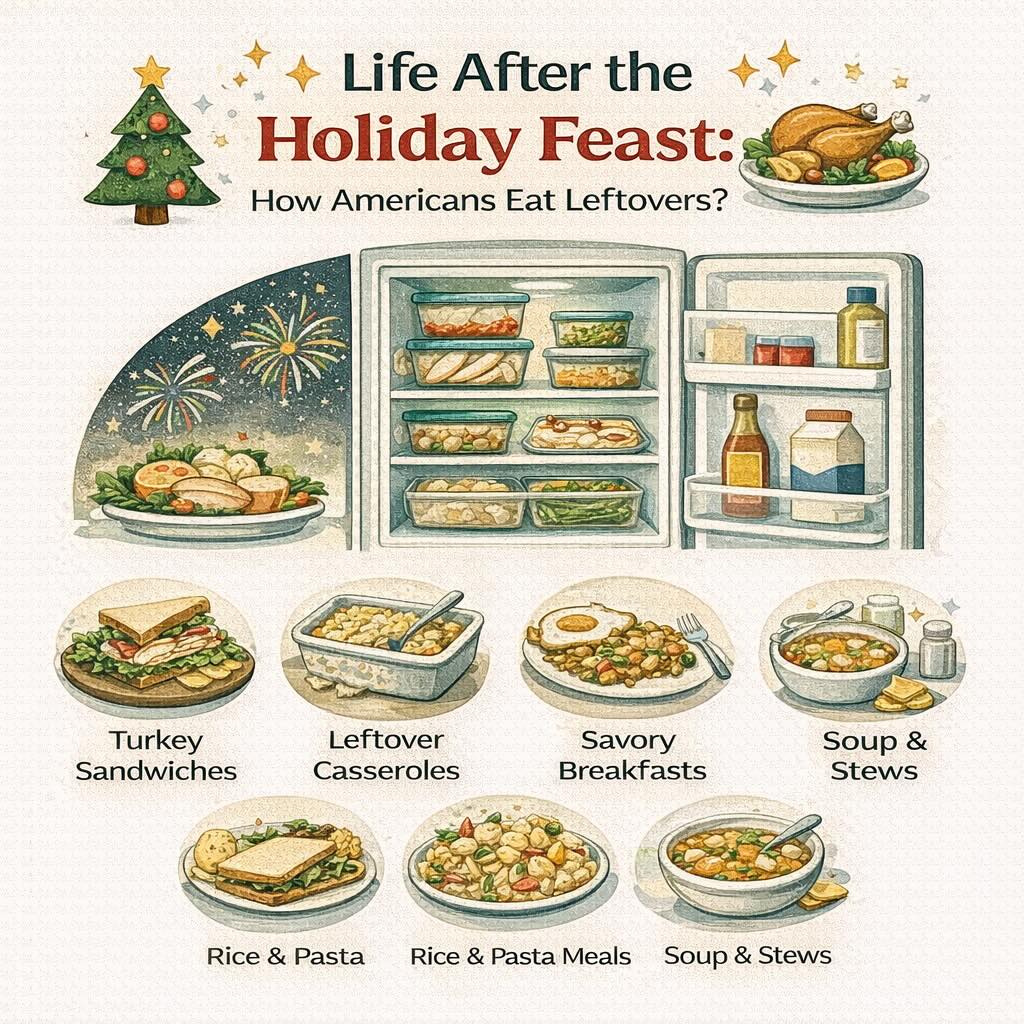
Many Asians spending their first Christmas in the U.S. open the fridge the next day and freeze:
"How many more days are we eating this...?"
"Won't it go bad? Isn't this a bit sad?"
But for Americans,
the end of Christmas dinner doesn't mean clearing the table. It means the leftover cycle begins.
And it's a very serious, very organized one.
🧠 1. The main point first: in the U.S., leftovers aren't "food nobody wants"
In American culture:
-
leftover ≠ making do
-
leftover ≠ saving money because you have to
-
leftover = the next meal, already planned
When many families prepare Christmas dinner, they already assume:
👉 it will be eaten over 3–5 days.
So the huge portions you see aren't out of control. They're by design.
🍗 2. The turkey's fate: not the main dish, but "the starting ingredient"
What Asians find hardest to understand is this:
the turkey is clearly the star, so why is it taken apart the next day?
Because in American homes, what the turkey is really for is👇
✔ Day 1: Christmas dinner (the ritual)
-
Eaten in slices
-
With sauce
-
The whole family together
✔ Days 2–4: officially "repurposed"
Common ways to eat it:
-
Turkey sandwiches (with stuffing and cranberries)
-
Turkey salad
-
Turkey soup / stew
-
Turkey burritos
👉 For Americans,
eating the turkey for just one meal would actually be wasteful.
🥔 3. Mashed potatoes, stuffing and side dishes are the kings of leftovers
Many Asians think side dishes are just there to fill out the meal,
but in the world of leftovers, they're the main act.
Common second lives👇
-
Mashed Potatoes
→ add cheese and bake it
→ add eggs for a breakfast plate -
Stuffing
→ fry into patties
→ stuff into a sandwich -
Green Bean Casserole
→ just heat it up and eat it again (no second thoughts at all)
👉 The American logic is:
how good it tastes doesn't matter much; what matters is being able to eat it again quickly.
🥧 4. Dessert isn't "finished today"; it's "eaten slowly"
In the U.S., a pie (Pie) is rarely "finished the same day."
The reason is simple:
-
It's sweet
-
The portions are big
-
It's meant to be eaten over several days
A common rhythm:
-
Day 1: a small slice after dinner
-
Day 2: with coffee
-
Day 3: for breakfast (really)
👉 In the U.S.,
dessert for breakfast isn't losing control. It's normal.
🧊 5. How long do leftovers keep? Americans actually have an unspoken rule
Many newcomers worry: "Is this really safe?"
The common understanding in American homes is:
-
Within 3–4 days in the fridge: fine to eat
-
Soups and stews (turkey soup included) are the same: finish them within 3–4 days in the fridge; to keep them longer, divide them into portions and freeze (best flavor within 2–3 months)
-
After that, throw it out, no agonizing
And they will:
-
Divide it into portions quickly
-
Use clear containers
-
Write the date on it (some families really do)
👉 It's not that they don't worry about food going bad. They have a set of rules for judging it.
🛒 6. Why are Americans so used to leftovers?
There are actually three very practical reasons:
1️⃣ After Christmas, nobody wants to cook again
2️⃣ The portions are made for "several meals" from the start
3️⃣ Eating out right after the holidays actually costs more
So for them, leftovers are:
👉 a way to get life back into its normal rhythm.
🧭 7. Where Asians most often misunderstand leftovers
❌ Misunderstanding 1: eating leftovers is sad
→ In the U.S., leftovers mean your home was full of people and fun yesterday
❌ Misunderstanding 2: it's not fresh
→ Most dishes are made to be reheatable
❌ Misunderstanding 3: it's rude to take food home
→ Americans love it when you pack some up to take with you
👉 If you don't take any, they'll actually think it's a waste.
🎯 Final thoughts: leftovers aren't what's left after the party; they're the holiday carrying on
If you look at an American Christmas table from the Asian "it has to be fresh" point of view,
it will seem very strange.
But once you understand that:
-
The portions are planned
-
How it gets eaten is planned
-
Leftovers are part of everyday life
you'll see that
an American holiday is really about making the next few days easier.
Once you know this, the next time you open the fridge,
you won't be questioning everything anymore.