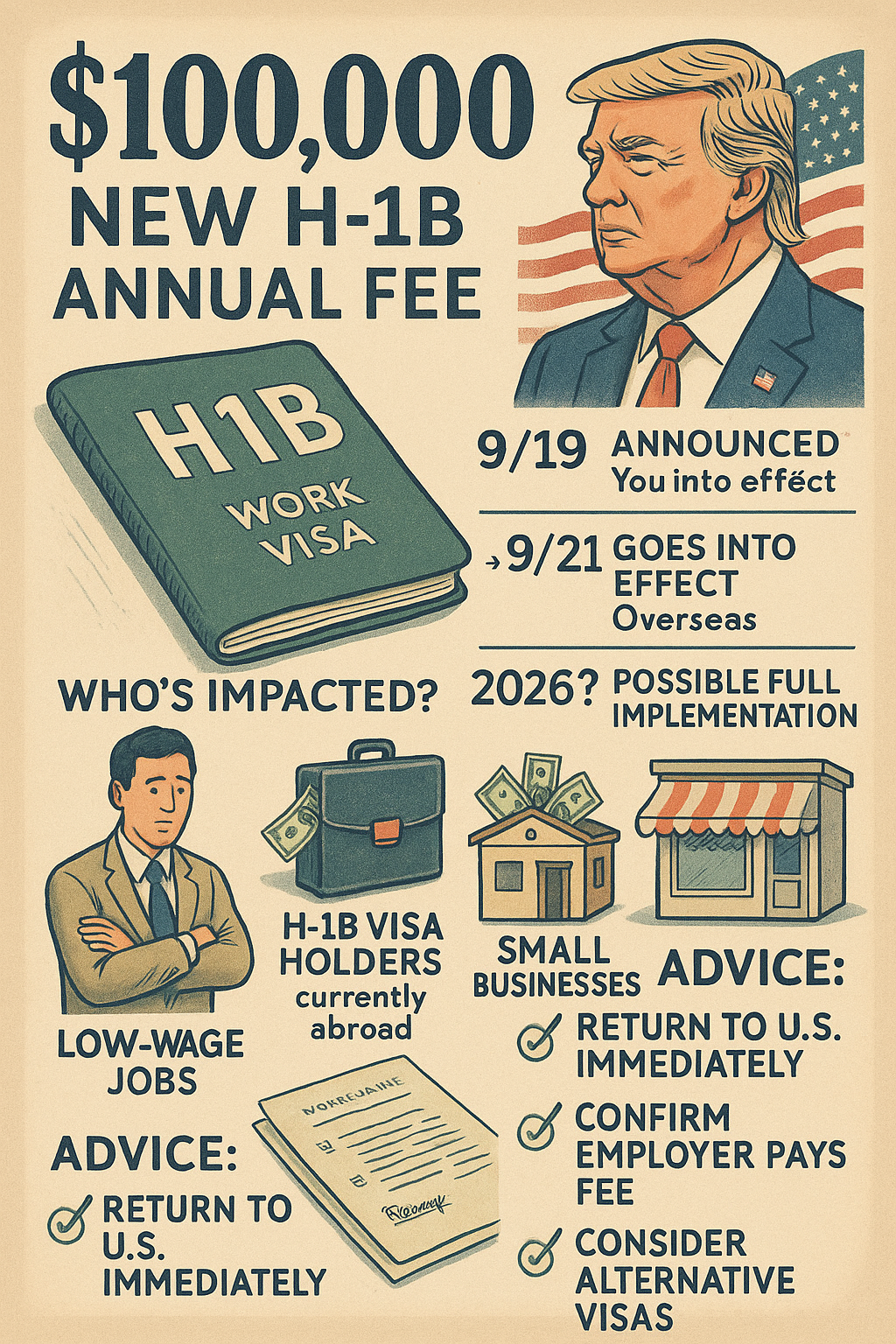
[Urgent Update] Trump Announces a $100,000 Annual H-1B Fee! Do Holders Abroad Have to "Return to the U.S. Within 24 Hours" to Be Safe?
Wow. Yesterday one piece of news shook the entire H-1B community: the Trump administration signed a new executive order "imposing a $100,000 annual fee" (Annual Fee) on H-1B visa applicants and people returning to the U.S. Many H-1B employees who were traveling or living abroad got urgent notices from their companies telling them to return before the new rule takes effect, and some people even had their flights canceled after boarding. What exactly happened? And what does it mean for you and me? Here's the full picture.
📌 Policy timeline and key dates
Date
Event
2025-09-19
Trump signs an executive order announcing the new H-1B annual fee: every H-1B visa applicant must pay an extra $100,000 fee every year. AP News+2AP News+2
Same day
The proclamation says it takes effect on September 21, 2025. Anyone who wants to apply for an H-1B or return to the U.S. from abroad after that date may be refused entry, or have their application denied or put on hold, if their employer hasn't paid the fee. Business Insider+2AP News+2
Mid-September
Many tech companies (Big Tech) send out notices reminding employees that H-1B holders who are traveling or abroad must return to the U.S. before the deadline to avoid being affected by the new rule. Some people had their trips canceled after already boarding at the airport. Business Insider+1
📌 What the policy says and how it works
Who it covers: New H-1B applicants and people renewing; it also covers H-1B visa holders currently abroad who are returning to the U.S. If the employer hasn't paid the $100,000 fee, the worker may not be able to return or enter the U.S. Business Insider+2Hindustan Times+2
What the fee is for: The government says the aim is to curb the "low-wage replacement" of American workers and encourage companies to hire more highly skilled local U.S. talent. The fee is far more expensive than the current $215 application fee or other administrative fees. Financial Times+2Hindustan Times+2
Effective date: Starting September 21, 2025, it becomes a condition for "leaving/returning to the U.S." or for the application process. Anyone who has left the country and wants to return after that date must confirm that their employer has taken care of the fee. Business Insider+2AP News+2
⚠️ What it means for H-1B holders and future applicants
If you're abroad, or you have a short trip or family plans that take you out of the U.S., your company may well send you an urgent notice to come back right away so you aren't refused entry under the new policy.
If you were just selected for an H-1B but haven't formally entered the U.S. yet, you may have to pay this annual fee to enter if you're traveling or staying outside the U.S.
It's very hard on small and mid-sized companies and startups, because the fee is a huge burden; with costs pushed up, companies may well be less willing to hire foreign employees.
💡 What to do: steps that can still protect you and help you get through this
If you're abroad or traveling: Arrange to return as soon as possible and be inside the U.S. before 9-21. If you arrive after that date and the annual fee hasn't been paid, you may be refused entry.
Check with your employer whether it's willing to pay the $100,000 fee. Some companies may have already started emergency procedures. If your company isn't willing, you need to assess whether you can keep working there.
Find out whether your H-1B is Cap-Exempt (for example, at a research institution or university). These usually have different rules and exemptions, and may not be affected by the new fee or the entry restrictions.
Consider other visas: If the H-1B route doesn't work out, look at the O-1 (extraordinary ability), the L-1 (intracompany transfer), or even job opportunities in other countries, or hybrid/remote work.
Stay informed: Follow immigration lawyers, official announcements and your company's internal notices. Some rules may be suspended or changed after court challenges.
🔮 What could change: how this policy might be revised or blocked
Legal challenges: Many experts believe such a high annual fee and the entry restrictions may be unconstitutional, because Congress has the power to set visa fees.
Unclear implementation details: Details such as which kinds of "return to the U.S." count as "departure," when it takes effect and whether there are exemptions may be revised in court or through administrative procedures.
Pressure from holders abroad and from companies: If large numbers of foreign H-1B employees can't travel abroad, or companies cut hiring because of the cost, business and diplomatic pressure may push the policy to be relaxed.
✅ Final thoughts
Trump's new policy is a much bigger shock than the earlier "wage-based ranking" plan: with a $100,000-a-year fee plus the risk of traveling abroad and coming back, many people have to make decisions right away.
If you're on an H-1B now or getting ready to apply, don't wait for the news to get worse before you prepare. Assess your situation now, negotiate with your company, make sure you can get back to the U.S. before the deadline, or have a backup plan.