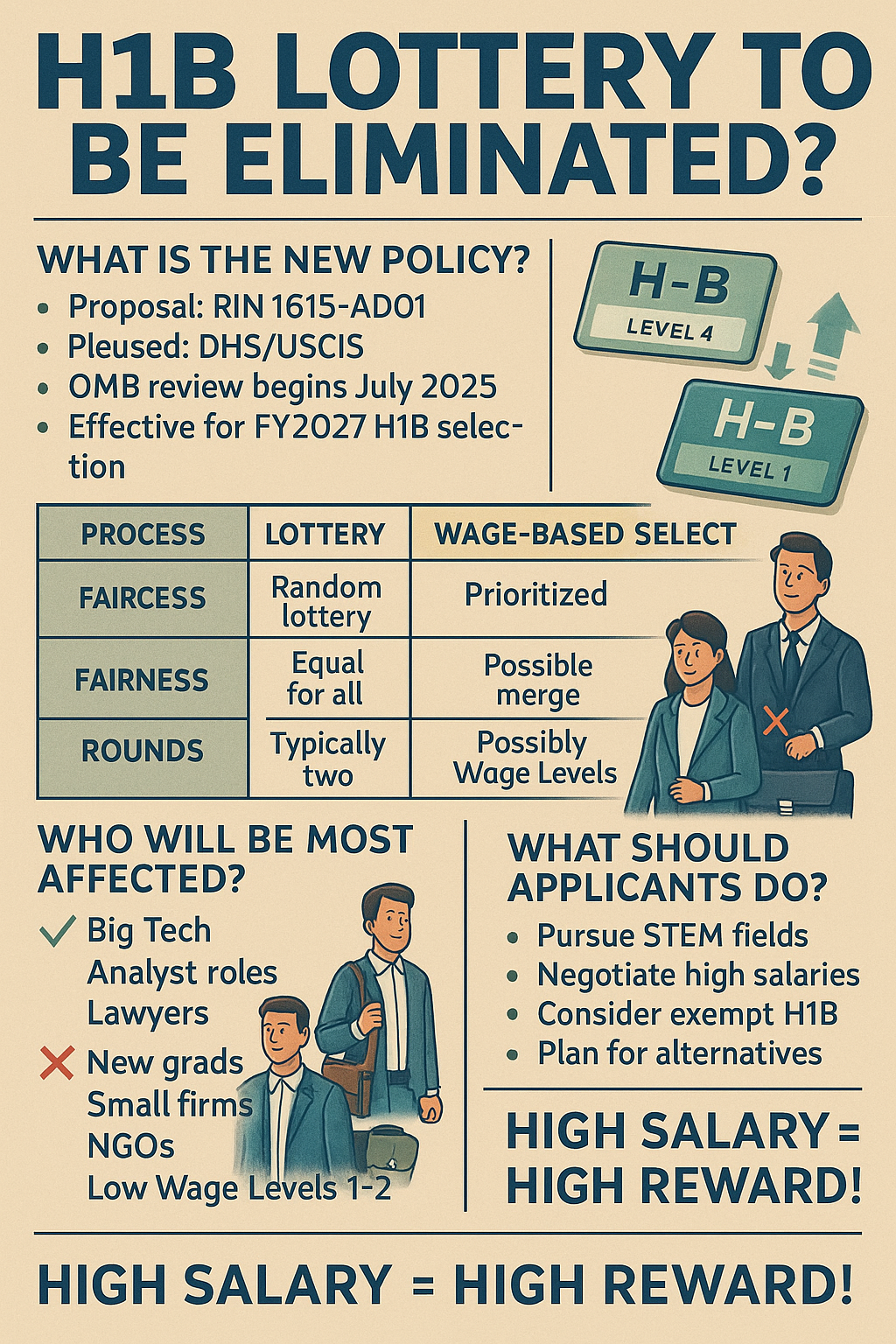
The U.S. government plans to scrap the lottery and replace it with a “whoever earns more goes first” system. For international students and employees of small companies, this is a major earthquake! But don’t panic. In this article we’ll sort it all out:
-
What is the new system?
-
Who will be hit hardest?
-
What can you do about it?
🔹 1. What is the policy? Who proposed it? When does it start?
This change comes from the U.S. Department of Homeland Security (DHS) and U.S. Citizenship and Immigration Services (USCIS). Its official name is:
📌 Proposal number: RIN 1615-AD01
Current status:
-
✅ In July 2025 it entered review at the White House Office of Management and Budget (OMB)
-
🔜 Review process: 90-day review period + 60-day public comment period
-
📆 Expected start: takes effect with the March 2026 H-1B lottery (FY2027)
In other words, you may well be among the first test subjects of this reform!
🔹 2. How is it different from the current lottery?
| Item | Current system | Proposed new system |
|---|---|---|
| 🎯 How applicants are selected | Completely random lottery | Ranked by wage level (Wage Level 4 → 1) |
| ⚖️ Fairness | Everyone has the same chance, regardless of salary | The higher the salary, the higher the priority, and the much better the odds of being selected |
| ⏳ Lottery rounds | Usually two rounds (Regular Cap + Master Cap) | May be merged into a single ranking |
To put it bluntly: people with low salaries, liberal arts backgrounds, or who just graduated may be knocked out outright.
🔹 3. These people will be hit hardest!
✅ Groups that benefit:
-
Big Tech engineers (Google, Amazon, Meta)
-
Professional roles such as legal and financial consulting
-
STEM fields + senior positions that require deep experience
❌ High-risk list:
-
International students early in their OPT
-
Employees of startups, small companies and NGOs
-
Salaries at Wage Level 1-2 (e.g. entry-level jobs, liberal arts graduates)
-
Backgrounds in art, design, the humanities and social sciences
Still in school? Working as an assistant at a small company? It may really be time to think about a Plan B……
🔹 4. What can applicants do now? (Strategies)
✅ Long live STEM!
Moving into science, technology, engineering or math not only extends your OPT (up to three years), it also makes it easier to negotiate a high salary and land in the high-priority ranks.
✅ Pick your employer carefully!
A high salary alone isn’t enough. Whether your employer will cooperate with the application, and what wage level it offers, will be key. You may need to practice how to “negotiate your pay.”
✅ Find another way in!
The following options are not subject to the H-1B cap (Cap Exempt):
-
Positions at universities and research institutions (such as UCLA and Stanford)
-
Apply for L1 / O1 / E2 or other alternative visa types 👉 Further reading: The complete guide to U.S. visas
✅ A backup plan abroad
Planning to work remotely, or going back to Taiwan to build work experience before returning to the U.S., is also a Plan B for many people.
🔹 5. Final thoughts: the one constant in immigration policy is “talent first”
Oh no, the H-1B is changing again! Does it feel like the policy changes every year?
But the one thing that never changes is: the U.S. wants talent that creates value. When the lottery is no longer random, can you stand out under “higher pay first”? Now is the time to decide your direction.
📌 Recommended further reading: